SEO vs GEO vs AEO
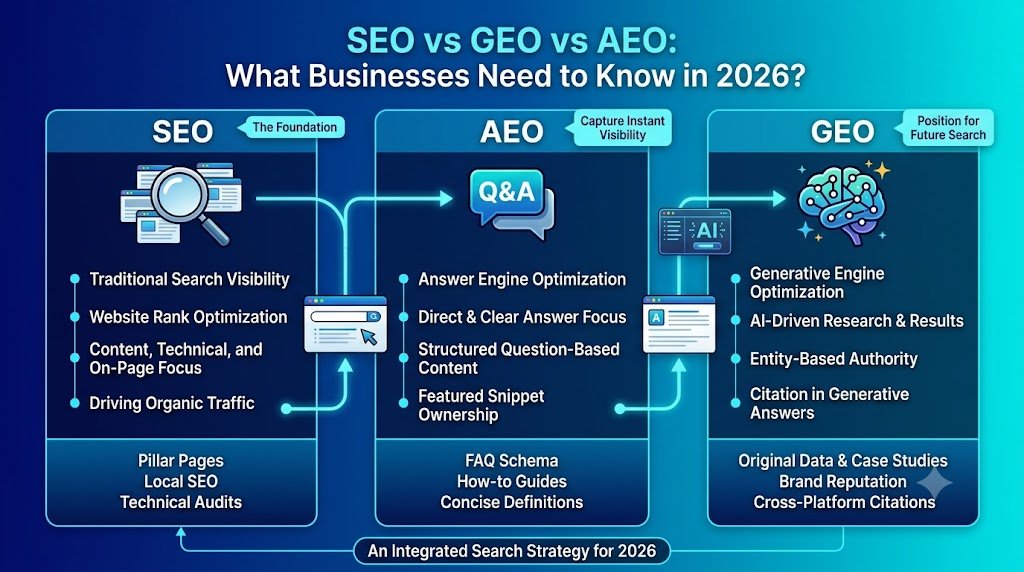
SEO vs GEO vs AEO: What Businesses Need to Know in 2026? Search is changing. People increasingly use not only traditional search engines but also AI-powered experiences to discover information. This has created new marketing terms such as: But what do these terms actually mean? And do businesses need a completely new strategy? The answer is more nuanced. Google’s current guidance says the fundamental SEO practices remain relevant to AI features such as AI Overviews and AI Mode. It also notes that there are no additional technical requirements or special schema needed specifically to appear in these AI features. What Is SEO? SEO = Search Engine Optimization SEO focuses on improving a website’s visibility in search engines. Traditional SEO includes: The goal is to make useful content discoverable for relevant searches. What Is AEO? AEO = Answer Engine Optimization The term is generally used to describe efforts to make content useful for answer-oriented search experiences. For example, content may be structured around questions such as: What is digital marketing? How does SEO work? How much does website development cost? AEO emphasizes clear answers and question-based content. What Is GEO? GEO = Generative Engine Optimization The term is used to describe efforts aimed at visibility in generative AI search experiences. However, businesses should be careful about treating GEO as a completely separate technical discipline. Google’s 2026 guidance specifically says that optimizing for generative AI search is fundamentally still about applying SEO best practices to the search experience. SEO vs AEO vs GEO Area SEO AEO GEO Main focus Search visibility Direct answers Generative AI experiences Content Search-focused Question/answer focused Useful, contextual content Keywords Important Helpful Helpful but not everything Technical SEO Important Important Important Original information Valuable Valuable Particularly valuable Internal links Important Important Important Human expertise Important Important Very important These categories can overlap rather than functioning as completely separate marketing systems. Does SEO Still Matter in AI Search? Yes. Google’s current documentation explicitly states that existing SEO fundamentals remain relevant for AI features in Google Search. AI search systems still need to discover and retrieve useful web content. Google says AI features can use information from its Search index and surface links to relevant pages. How Businesses Can Prepare 1. Create Useful Content Don’t publish generic articles just to target keywords. Answer real customer questions. 2. Demonstrate First-Hand Knowledge Instead of writing: “SEO is important for businesses.” Show: Google’s people-first guidance emphasizes original information, analysis and first-hand expertise. 3. Create Topic Clusters For Alfluencia, for example: Pillar SEO Services Supporting blogs: This creates a connected knowledge structure. 4. Use Internal Links Your blog should link to relevant service pages. For example: SEO vs GEO vs AEO ↓ Alfluencia SEO Services ↓ Content Creation Services ↓ Website Design & Development Google recommends relevant links because they help users and search engines discover other pages. 5. Don’t Chase “AI Hacks” There are many claims about special tricks for getting mentioned by AI systems. Google’s current guidance says businesses should focus on established SEO fundamentals and useful, unique content rather than tactics such as unnecessary AI-specific files or attempts to manipulate AI mentions. What Should Alfluencia Focus On? For your agency, the strategy can be: SEO ↓ Helpful Content ↓ Strong Website ↓ Original Expertise ↓ Social Distribution ↓ Brand Authority ↓ AI Search Visibility Instead of treating SEO, AEO and GEO as three completely disconnected services, position Alfluencia around search visibility across traditional and AI-powered search experiences. Conclusion SEO, AEO and GEO are often presented as completely different worlds. In practice, there is significant overlap. The foundation remains: Useful Content + Technical Accessibility + Clear Structure + Relevant Information + Original Expertise + Strong User Experience For businesses, the focus should be less on chasing terminology and more on building a website that provides information people genuinely want to find.