People are no longer relying only on Google to find information. They are increasingly asking AI tools such as ChatGPT, Google AI Overviews, Microsoft Copilot, Perplexity, and other AI-powered search platforms for direct answers.
Instead of searching “best digital marketing agency near me”, a user might ask an AI:
“Which digital marketing agencies in Delhi are best for small businesses, and what services do they offer?”
This change creates a new opportunity for website owners, bloggers, businesses, and digital marketers.
But there is one important question: How do you get your website to appear in AI-generated answers?
The answer is not simply adding more keywords to your website. AI search requires a broader approach that combines SEO, high-quality content, topical authority, technical optimization, structured information, and brand credibility.
In this guide, we’ll understand how AI search works and explore practical strategies to improve your website’s chances of being discovered, cited, and mentioned by AI search engines.
What Is AI Search?
AI search refers to search experiences where artificial intelligence understands a user’s question and generates a direct answer instead of simply displaying a list of traditional search results.
Platforms such as ChatGPT, Google AI Overviews, Microsoft Copilot, and Perplexity can combine information from different sources to provide users with summarized answers.
For example, instead of showing:
- Website A
- Website B
- Website C
- Website D
an AI search system may provide a summarized answer and mention or cite several websites that it considers useful and trustworthy.
This means businesses now need to think beyond “How do I rank on Google?”
A better question is:
“How do I make my website a reliable source that AI systems can understand and use?”
Why AI Search Optimization Matters in 2026
Traditional SEO is still important, but the way people discover information is evolving.
AI search can influence:
- Website visibility
- Brand awareness
- Organic traffic
- Customer discovery
- Online reputation
- Leads and conversions
- Brand mentions
- Search visibility across multiple platforms
For businesses, this means being visible in AI-generated answers can become another important part of a successful digital marketing strategy.
The goal isn’t necessarily to “rank first in ChatGPT.”
Instead, you should aim to make your website:
Easy to crawl → Easy to understand → Useful → Trustworthy → Worth mentioning
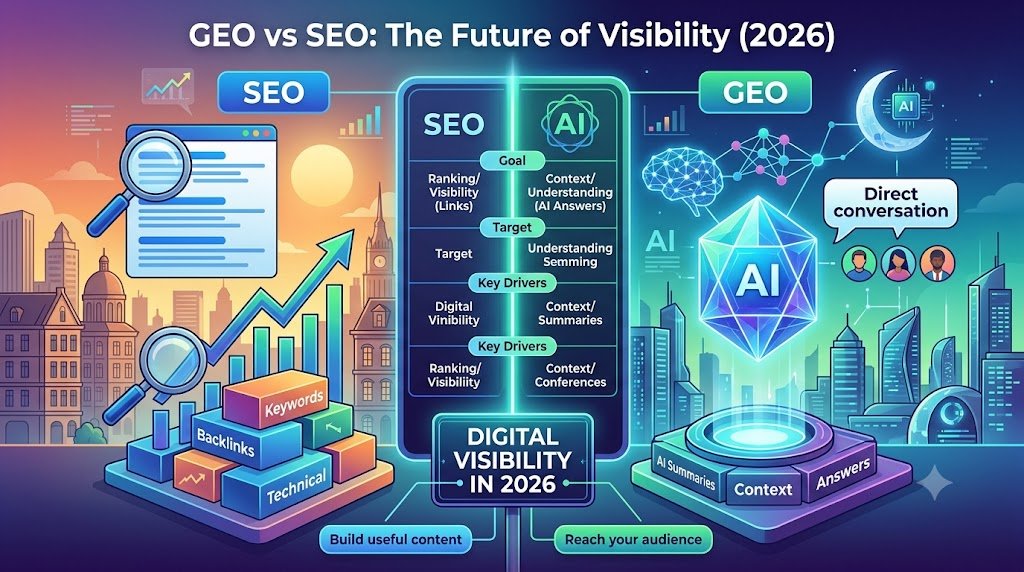
SEO vs AI Search Optimization: What’s the Difference?
SEO and AI search optimization are closely connected, but they aren’t exactly the same.
Traditional SEO focuses heavily on helping search engines understand that a page is relevant for a particular query.
AI search optimization goes one step further.
Your content needs to provide information that an AI system can confidently understand, extract, summarize, and potentially reference.
| Traditional SEO | AI Search Optimization |
|---|---|
| Focuses on rankings | Focuses on visibility in AI answers |
| Targets keywords | Targets topics, entities and user questions |
| Optimizes webpages | Optimizes information and context |
| Backlinks are important | Authority and trustworthy mentions matter |
| Search snippets matter | Clear, extractable answers matter |
| Search engine visibility | Multi-platform search visibility |
The good news is that strong SEO fundamentals are still the foundation of AI search visibility.
How to Rank Your Website in AI Searches
Now let’s look at the strategies you can actually implement.
1. Create High-Quality, Helpful Content
The first and most important step is creating content that genuinely helps people.
AI systems have no reason to rely on a page that provides little original value.
Instead of creating an article simply because a keyword has search volume, ask:
“What problem is my reader trying to solve?”
For example, rather than writing a generic article titled:
“Digital Marketing”
you could create:
“How to Create a Digital Marketing Strategy for a Small Business in Delhi”
The second topic answers a specific problem and provides useful context.
Long-tail keyword examples
Naturally incorporate phrases such as:
- how to rank a website in AI search
- how to get your website mentioned in AI search results
- how to optimize a website for AI search
- how to rank on ChatGPT search
- how to improve website visibility in AI search
- AI search optimization strategies for websites
- how to make a website visible in AI-generated answers
Don’t force these keywords into every paragraph. Use them where they naturally fit.
2. Answer Questions Directly
AI search users often ask questions in conversational language.
Your content should do the same.
Instead of writing long introductions before answering a question, provide a clear answer early.
For example:
How can I optimize my website for AI search?
You can optimize your website for AI search by publishing helpful and authoritative content, answering specific user questions, improving technical SEO, using structured data where appropriate, building brand authority, and making your information easy for search engines and AI systems to understand.
Then expand on the answer.
This structure makes your content easier for both humans and machines to interpret.
3. Target Long-Tail and Conversational Keywords
AI search has made conversational queries increasingly important.
Users don’t always search using short keywords anymore.
They ask complete questions.
For example:
Short keyword:
AI SEO
Long-tail query:
How can I optimize my website for AI search engines?
Conversational query:
What should I do if I want ChatGPT and Google AI to find my website?
Your content should cover all three types naturally.
Useful long-tail keywords for AI search SEO
Some relevant long-tail keywords include:
- how to rank website in AI search engines
- how to optimize content for AI search engines
- how to get cited by AI search engines
- how to increase visibility in AI-generated search results
- how to make content appear in ChatGPT search
- how to optimize website for ChatGPT and Perplexity
- how to improve website visibility in Google AI Overviews
- best AI SEO strategies for small businesses
- how AI search affects traditional SEO
- how to prepare a website for AI search
4. Build Topical Authority
One article isn’t enough to establish your expertise in a competitive topic.
Imagine you have a website about digital marketing.
Instead of publishing one article about SEO, create a group of closely related articles.
For example:
Main topic: SEO
Supporting topics:
- What is SEO?
- How does technical SEO work?
- How to perform keyword research
- How to optimize a blog post
- What is local SEO?
- How to build backlinks
- How to optimize content for AI search
- What is entity SEO?
- How does Google AI search work?
These pages can internally link to each other.
This creates a topic cluster.
Over time, your website can demonstrate deeper expertise around the subject rather than appearing to have one isolated article.
5. Make Your Content Easy for AI to Understand
AI systems need to understand the meaning and context of your content.
A complicated wall of text makes that harder.
Use:
- Clear headings
- Short paragraphs
- Bullet points
- Numbered lists
- Tables
- Definitions
- FAQs
- Step-by-step instructions
- Descriptive subheadings
For example:
Instead of writing one 500-word paragraph about technical SEO, break it into:
What Is Technical SEO?
Why Is Technical SEO Important?
Technical SEO Checklist
Common Technical SEO Problems
How to Fix Technical SEO Issues
This improves readability for users and creates clearly defined information sections.
6. Use Structured Data Where Appropriate
Structured data helps search engines understand specific information on a webpage.
Depending on the content, websites may use structured data for things such as:
- Articles
- Products
- Organizations
- Local businesses
- Events
- FAQs
- Reviews
- Breadcrumbs
However, structured data isn’t a magic trick for appearing in AI answers.
It should accurately represent the content that users can actually see on the page.
Think of structured data as additional context, not a shortcut to rankings.
7. Strengthen Your Website’s E-E-A-T Signals
Google’s quality systems place importance on Experience, Expertise, Authoritativeness, and Trustworthiness (E-E-A-T).
These principles are also useful when thinking about AI search visibility.
Your website should clearly communicate:
Who created the content?
Include author information where appropriate.
Why should users trust you?
Show credentials, experience, case studies, testimonials, or relevant expertise.
Is your information accurate?
Keep important information updated.
Does your business actually exist?
For businesses, provide consistent information about your company, services, location, and contact details.
The more transparent your website is, the easier it becomes for users and search systems to understand who is behind the information.
8. Build Brand Authority Beyond Your Website
Your website isn’t the only place where your brand should exist.
AI systems may encounter information about your business across different online sources.
Build a consistent digital presence through relevant:
- Business directories
- Industry websites
- Professional profiles
- Social media
- News publications
- Reviews
- Local listings
- Guest contributions
- Community discussions
For example, if your company is described consistently across multiple reputable sources, it can strengthen your overall online presence.
Keep your business information consistent
Try to maintain consistency in:
- Business name
- Website
- Contact information
- Address
- Services
- Company description
This is particularly important for local businesses.
9. Earn High-Quality Backlinks
Backlinks remain an important part of SEO.
But don’t think:
“I need hundreds of backlinks.”
Think:
“I need relevant websites to recognize my content as useful.”
A backlink from a respected website within your industry can be more valuable than dozens of irrelevant links.
Some ways to earn backlinks include:
- Publishing original research
- Creating useful resources
- Producing statistics and data
- Writing expert guides
- Digital PR
- Industry collaborations
- Guest contributions
- Creating link-worthy tools
The objective is to build genuine authority rather than manipulate search rankings.
10. Create Original Information
This is one of the strongest opportunities for AI search optimization.
AI systems need reliable information to answer questions.
If your website simply rewrites information that already exists everywhere, there may be little reason for your content to stand out.
Instead, create something original.
For example:
- Original surveys
- Industry statistics
- Case studies
- Expert interviews
- Experiments
- Proprietary data
- Research reports
- Unique frameworks
- Detailed comparisons
Original information gives other websites something worth referencing.
And when other websites reference your work, your authority can grow.
11. Optimize Your Website for Local AI Searches
Local businesses should pay particular attention to AI-powered local searches.
People may ask:
“What are the best footwear shops near me?”
or:
“Where can I buy affordable formal shoes in Delhi?”
To improve local visibility, make sure your business information is accurate across your online presence.
Focus on:
- Google Business Profile
- Local citations
- Business directories
- Reviews
- Location-specific website pages
- Consistent NAP information
- Local keywords
- Useful location-based content
For example, instead of targeting only:
“footwear shop”
you could naturally target:
“best footwear shop in Janakpuri”
or:
“affordable footwear store in West Delhi.”
The key is to provide genuine local information rather than simply repeating a location keyword.
12. Improve Your Technical SEO
Great content cannot perform well if search engines struggle to access your website.
Check important technical SEO factors such as:
Website crawlability
Make sure search engine crawlers can access important pages.
Indexability
Check that important pages aren’t accidentally blocked from indexing.
Website speed
Improve page performance, particularly on mobile devices.
Mobile usability
Your website should work smoothly across smartphones, tablets, and desktops.
Internal linking
Connect related pages logically.
HTTPS
Use a secure HTTPS connection.
XML sitemap
Maintain an accurate XML sitemap containing important indexable URLs.
Technical SEO creates the foundation that allows your content to be discovered and understood.
13. Don’t Ignore Traditional Google SEO
One common mistake is thinking:
“AI search means traditional SEO doesn’t matter anymore.”
That’s not the right approach.
Traditional SEO still matters.
Continue focusing on:
- Search intent
- Keyword research
- Helpful content
- Technical SEO
- Internal linking
- Backlinks
- Page experience
- Website architecture
- Authority
AI search optimization should be viewed as an extension of good SEO, not a complete replacement for it.
14. Add a Strong FAQ Section
FAQs can help you cover specific questions that your audience is likely to ask.
For example, an article about AI search optimization could include:
Can I rank my website on ChatGPT?
There isn’t a traditional keyword-ranking position on ChatGPT equivalent to Google’s blue-link rankings. Your goal should instead be to build a website that AI systems can discover, understand, and consider a useful source.
How long does AI SEO take?
There is no guaranteed timeframe. Visibility depends on factors such as website authority, content quality, competition, technical SEO, brand mentions, and how frequently information is updated.
Is AI SEO different from traditional SEO?
AI SEO overlaps heavily with traditional SEO but places additional emphasis on conversational queries, clear information, topical authority, entity understanding, and content that can be confidently summarized or referenced.
FAQs naturally capture question-based searches while making your content easier to navigate.
15. Keep Your Content Fresh
AI search is evolving quickly.
Information that was accurate a year ago may become outdated.
Review important pages regularly and update:
- Statistics
- Examples
- Screenshots
- Tools
- Industry trends
- Product information
- Links
- Recommendations
Don’t update content just to change the publication date.
Make meaningful improvements that genuinely make the page more useful.
16. Optimize for Entities, Not Just Keywords
Modern search engines don’t only look at individual words.
They also try to understand entities and relationships.
For example, if your website discusses:
Digital Marketing
you could naturally cover related entities such as:
- SEO
- Content marketing
- Social media marketing
- PPC
- Email marketing
- Local SEO
- Google Business Profile
- Analytics
This creates a clearer context around your expertise.
The goal isn’t to stuff related words into your page.
Instead, build comprehensive content that naturally covers the important concepts surrounding your main topic.
17. Write for Humans First
This might sound obvious, but it is one of the most important rules.
Don’t write:
“AI search optimization services provide AI SEO optimization for AI search engines to optimize AI search rankings.”
That’s keyword stuffing.
Instead, write naturally:
“AI search is changing how people discover businesses online. To improve your visibility, focus on useful content, technical SEO, topical authority, and a strong online presence.”
The second version sounds like something a real person would write.
And that’s exactly what you want.
AI Search Optimization Checklist
Before publishing a page, use this checklist:
Content
☐ Does the page answer a genuine user question?
☐ Is the information accurate?
☐ Does it provide original value?
☐ Are important questions answered clearly?
SEO
☐ Is the primary keyword naturally included?
☐ Are relevant long-tail keywords covered?
☐ Does the page match search intent?
☐ Are internal links included?
AI Search
☐ Can an AI system easily understand the main answer?
☐ Are important facts clearly stated?
☐ Are headings descriptive?
☐ Does the page demonstrate expertise?
Technical SEO
☐ Is the page crawlable?
☐ Is it indexable?
☐ Does it work well on mobile?
☐ Is the website secure?
☐ Are important pages internally linked?
Authority
☐ Does your website have relevant backlinks?
☐ Is your business information consistent?
☐ Are you building mentions across reputable websites?
☐ Do you have genuine reviews, case studies, or proof of expertise?
Common Mistakes to Avoid in AI SEO
Keyword Stuffing
Repeating “AI search optimization” dozens of times won’t automatically improve visibility.
Publishing AI-Generated Content Without Editing
AI can help with research and drafting, but blindly publishing generic content can make your website less useful.
Add human experience, examples, opinions, original research, and practical insights.
Creating Hundreds of Low-Quality Pages
More pages don’t automatically mean more visibility.
A smaller collection of genuinely useful resources can be more valuable than hundreds of thin pages.
Ignoring Technical SEO
Even excellent content can struggle if your website has serious crawling, indexing, speed, or usability problems.
Chasing Every New AI SEO Trick
The AI search landscape changes quickly.
Instead of relying on questionable hacks, build the fundamentals:
Helpful content + technical SEO + authority + trust + clear information.
How Long Does It Take to Rank in AI Search?
There is no guaranteed timeline for appearing in AI-generated answers.
Your results can depend on:
- Website age
- Domain authority
- Competition
- Content quality
- Search demand
- Technical SEO
- Backlink profile
- Brand recognition
- Online mentions
- Content freshness
For a new website, building visibility can take time.
That’s why AI search optimization should be treated as a long-term digital marketing strategy, rather than a quick ranking trick.
The Future of SEO Is Becoming More Conversational
Search behavior is moving from simple keywords toward questions, conversations, comparisons, and complex requests.
Someone may not search:
“Best SEO agency Delhi.”
Instead, they might ask:
“I’m a small business owner in Delhi. Which SEO agencies would you recommend for improving local search visibility, and what should I look for before hiring one?”
This type of search requires content that demonstrates genuine knowledge and answers the user’s complete problem.
That is why the future of SEO isn’t simply about ranking for one keyword.
It’s about becoming a trusted source of information.
Final Thoughts: How to Rank Your Website in AI Searches
So, how do you rank your website in AI searches?
There isn’t one secret technique.
Instead, focus on building a website that search engines and AI systems can easily discover, understand, and trust.
Start with strong technical SEO. Create genuinely helpful content. Target conversational and long-tail queries. Build topical authority. Establish your brand across reputable platforms. Earn quality backlinks. Provide original information. Keep your content updated.
Most importantly, write for the person asking the question—not just the algorithm processing it.
The websites most prepared for the future of search will not necessarily be the ones using the most SEO tricks.
They will be the ones that consistently provide clear, accurate, useful, and trustworthy information.
And that’s the foundation of both modern SEO and AI search optimization.